
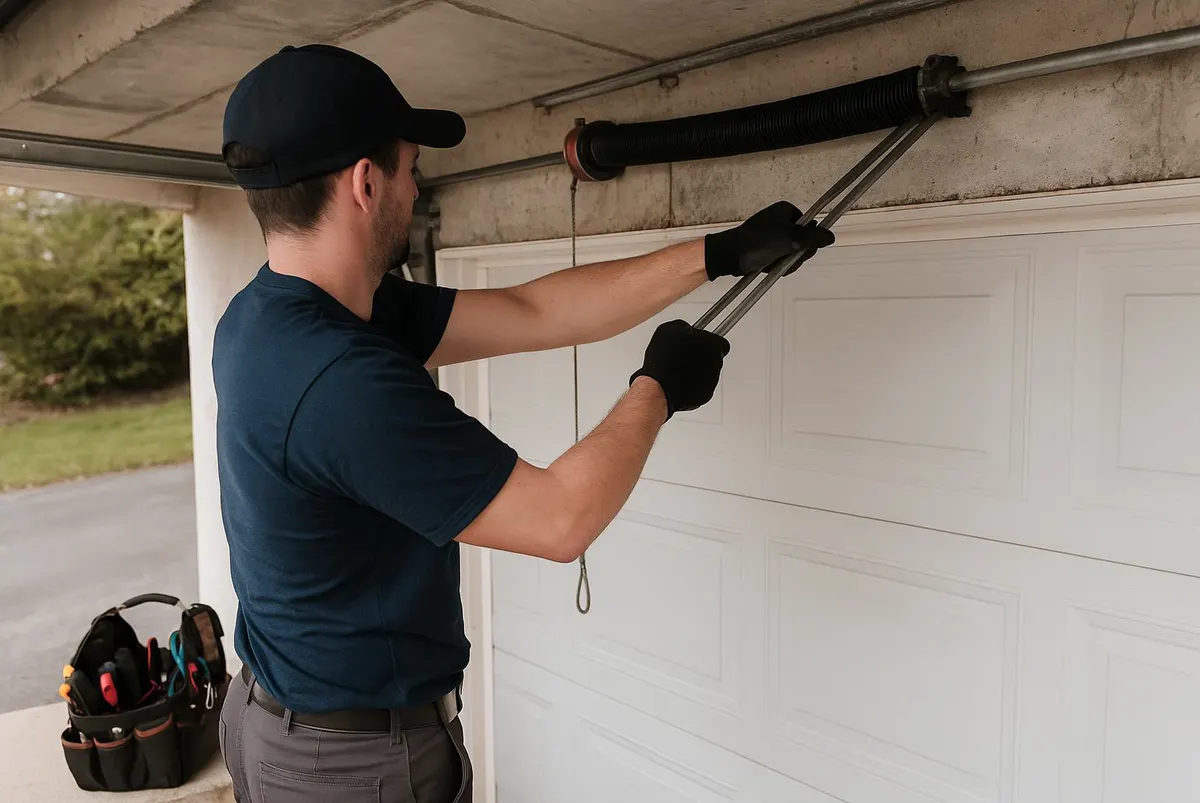
Rule of thumb: only pull the emergency release cord when the door is fully closed and the opener itself has failed. If the door is open, moving, or you have no idea whether a spring is broken, leave the cord alone. The exceptions are narrow — mainly situations where you have someone physically supporting the door's weight as you disconnect it, or you're doing a planned balance test with the door at rest. Outside of that, pulling the cord without thinking it through is how a thirty-pound trim piece turns into a two-hundred-pound hazard.
What the Cord Actually Does
The emergency release is a mechanical disconnect, nothing more. It unhooks a small trolley from the main drive carriage inside the opener's track, which is the only thing linking your garage door to the motor. Pull it, and the door is no longer controlled by the opener at all — it's just hanging there, held up by its springs and whatever you do with your hands. That's useful. It's also exactly why timing matters: the cord doesn't make the door safe, it just takes the motor out of the equation.
When the Cord Is Exactly the Right Tool
- Power outage. Ice storms are a regular part of winter here, and a line going down with your car trapped inside a closed garage is a common, fixable problem. With the door closed, pull the cord, lift the door manually, and drive out. Close it by hand behind you.
- Dead opener, door already down. If the motor burns out or the board fails while the door is sitting closed, the release lets you open it manually until a repair is scheduled.
- Balance testing. With the door closed, disconnect the opener, then lift the door by hand to about waist height and let go. A properly balanced door stays put. One that drifts up or drops down is telling you the springs are losing tension — worth noting before it becomes a bigger failure.
When Pulling It Makes Things Worse
The cord causes damage and injury almost exclusively in one scenario: the door is open, or partway open, when it gets disconnected. Once the opener is out of the picture, nothing is holding that door up except spring tension — and if a spring is already weak, cracked, or fully broken, there's nothing holding it up at all. A full-weight door in free fall can snap cables, jump the tracks, crush fingers or toes, and total anything parked underneath it.
A few specific situations to avoid:
- Pulling the cord with the door open. Always lower the door first, using the opener if it still runs at all, before disconnecting.
- A door that's already making noise or feels heavy. Grinding, sagging on one side, or a door that's hard to lift by hand usually means a spring is already compromised. Disconnecting it in that state is asking for a sudden drop.
- Mid-cycle disconnects. Pulling the cord while the door is actively opening or closing can let it fall off track entirely, bending rollers and hinges in the process.
- Kids treating it like a toy. The cord is low enough for curious hands to reach. An unexpected pull while an adult isn't watching the door is a real risk, especially in households with younger children.
How to Use It Safely
- If the opener still functions at all, use it to close the door completely first.
- Pull the cord straight down, not at a sideways angle — pulling off-axis can bend the trolley arm and cause problems reconnecting later.
- Keep a hand on the door as you disconnect it, in case it shifts unexpectedly.
- To reconnect, pull the cord toward the door itself (this resets the trolley), then run the opener through a full cycle so the carriage re-engages. You'll usually hear or feel a click when it catches.
- If the trolley won't re-engage, or the door doesn't move evenly after reconnecting, stop and get it looked at rather than forcing it.
A Note for This Time of Year
Heading into the colder months, outages from ice-loaded lines become more common across Hendricks County, and cold temperatures also make springs and hardware stiffer and slightly less forgiving. Spring storm season brings its own round of outages later in the year. Knowing how to use the release cord before you actually need it — ideally by doing a calm balance test now, door closed, nobody in a hurry — beats figuring it out for the first time during a blackout with the door already open and groceries melting in the car.
When to Call Brownsburg Garage Door Experts
If your balance test shows a door that won't hold position, or the door has felt heavier than normal lately, that's a spring problem, not a cord problem — and it's worth a proper spring replacement before the cord gets used in an emergency and the door drops hard. If the trolley won't reconnect cleanly, or the opener itself seems to be the real issue behind needing the manual release so often, our garage door opener repair and installation service can sort out whether it's a simple fix or time for a new unit. Either way, don't keep manually operating a door that won't stay balanced — that's exactly the setup for an injury.
If your garage door in Brownsburg, Avon, Plainfield, Danville, Pittsboro, Zionsville, Lizton, or Clayton isn't behaving the way it should on manual release, give Brownsburg Garage Door Experts a call. We'll check the springs, the trolley, and the opener, and get everything working the way it's supposed to before winter makes small problems bigger.